


 What's happening


Interview with Brigitte Weich and Karin Macher
The first question simply comes to mind: How can you actually make a film in North Korea? How did you choose such an unusual subject?
Brigitte Weich: The first is perhaps the easier question, and one I'm often asked. It's actually quite simple. In any case, that wasn't the biggest hurdle we had to overcome. The real hurdles were financing the project and the rights to the archive material. In North Korea, you basically can't do much on your own. As soon as you set foot on North Korean soil, you can't move freely, and you wouldn't get very far: you're not allowed to have any local money, there are no taxis, you're not allowed to use public transportation, and you wouldn't be able to communicate without Korean. If you want to film there, you need more than just an entry visa. Of course, you wouldn't get this permit if you wanted to film the secret nuclear tests.
So the challenge was to find a suitable subject?
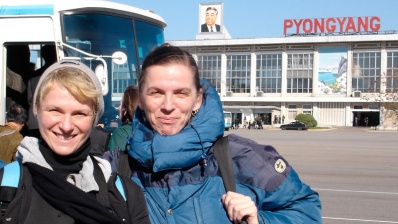
Brigitte Weich: That's the more difficult answer. The trigger was certainly my visit to the Pyongyang Film Festival in 2002. Two football films were playing there: one was "France, We're Coming!" by Michael Glawogger, and the other was "The Game of Their Lives," a British film about the North Korean football miracle team of 1966, familiar to any football fan. There was a lot of talk about football, which didn't really interest me until someone mentioned how good Korean women's football was. I then spent two weeks trying in vain to see a women's football match. It ultimately took until 2007, five years, until we finally got to Kim Il Sung Stadium for the first time. On my first visit, I had no idea how unthinkable it was in North Korea to spontaneously visit a football stadium.
In a way, that was the birth of film. Korfilm, a state film agency, produced the British film and essentially specialized in helping foreign teams film. Ryom Mi Hwa, a very dynamic and dedicated woman, is at work there, making many things possible beyond the rigid bureaucratic structures. I talked to her at the festival and said I was interested in a film about the women's soccer team. When I returned to Vienna, I received a fax from Korfilm asking what was happening with the project about women's soccer. That was really the beginning. It was a film I had wanted to see, but hadn't even considered making it myself.
What were the first steps?
Brigitte Weich: The fax gave me a decisive "foot in the door," because it demonstrated Korean interest in the topic. The Asian Championships in April 2003 were coming up, a good opportunity to find out more. Bangkok was a relatively easy and inexpensive destination, so I went. The North Koreans won the tournament and thus qualified for the World Cup. From the moment I met the team, I was hooked. A second universe had revealed itself to me: after the trip to North Korea, now women's football. When traveling to Pyongyang, you constantly feel like you're standing in front of dummies and aren't getting close to the real lives of the people. The female footballers, on the other hand, were "real people" who just happened to come from this inaccessible country. We accompanied them on tournament trips with our camera for two years until we filmed for the first time in Pyongyang. Since they all only spoke Korean, our contact at international tournaments was difficult, but they were cool girls, and I had a hard time imagining how they would function in this totalitarian system. That's a theme I wanted to explore in the film—the question of how everyday life functions in an environment that seemed so stage-like and alien to me—culturally and politically.
How quickly did it become clear that you would make the film yourself?
Brigitte Weich: There came a point where I no longer wanted to give up the subject matter as a storyteller. They were "my girls," my story, my interest. At a certain point, you can neither delegate something nor wait for someone else to do it for you. I originally didn't intend to produce it myself, even though I felt completely up to the management and financing tasks. It just so happened that Lotus Film supported me as a mentor. They gave me a camera for my first trip. An important initial impulse and important backing for the years that followed. The really daunting part was the creative work, because I had never done anything like that before. And making a commitment to work 24 hours a day, seven days a week, for seven years is a significant investment. The fascination with the content drove me; the question of giving up never occurred to me.
Karin Macher: Brigitte couldn't bring anyone else along on the first trips, which were only two or three people with camera and sound. However, she wouldn't have been able to pass on the personal relationship she developed with the actors during that time to a director.
Brigitte Weich: This intangible personal relationship was already formed in Bangkok through the shared experience of this amazing competition. In Bangkok, the camerawoman Judith Benedikt and I experienced one of those famous "magic moments." Since I had a camera at my disposal, I decided on the spot to bring someone with me who knew how to use it. Which wasn't easy: Who would agree to a short-notice project with someone who isn't a film director or has any filming experience? I didn't meet Judith Benedikt for the first time until I was in Bangkok, in the lobby of the youth hostel. It was in this mixed situation with a North Korean crew and two Austrians who had never met each other before that we got started. We returned completely enthusiastic, and from then on, it was clear to both of us: we wouldn't let this project go. In 2003, I met Karin Macher, who was working on a documentary project herself, and with whom I continued to exchange ideas. For two years, it was a matter of constantly staying on top of things, arranging financing and filming permits, and at the same time maintaining personal relationships with the people.
Karin Macher: You couldn't contact these actors. Once they returned to North Korea, they were gone again. Follow-up isn't possible unless you go there.
Brigitte Weich: And even if you do go, it's not that easy. North Koreans need official permission to contact foreigners.
The film begins with two quotes: one from Kim Jong-il (Great ideologies create great times), the second from Simone de Beauvoir (You are not born a woman, you become one). Can this film be viewed as an attempt to, on the one hand, shed light on a system that places people at its service and, on the other hand, to demonstrate that gender inequality is still an issue within a system of equality?
Brigitte Weich: I think it's analyzed correctly. But the chicken-and-egg theme is probably reversed. As a woman, I'm primarily interested in women's stories. It started with a gut feeling and only slowly developed into a structure. There were questions like: What are over- and underprivileged situations? Who is what in which system? How does something like this arise? Who are the slaves of the system? There have been and continue to be various fault lines and cross-sections—sexist, racist, class-based—throughout human history. Communism, for example, is a system that postulates the elimination of traditional underprivileges, but women are nevertheless more unequal within it. That's a very simple truth. The demand for equality was never realized in any form of real communism, yet the idea existed. In North Korea, a last vestige of it still exists, even though communism has played out globally. In contrast to class struggle, the gender struggle moves in a constant, boundless field of tension. The film offered the opportunity to examine this in a small nucleus, because the female soccer players are extremely privileged women. If one goes across all cultures, religions, social systems, or classes, there were and are various forms of privilege or underprivilege, and women are always initially on the side of the underprivileged. The opposite is happening with our women soccer players. Not because Kim Jong-Il is the greatest feminist of all time, but because by supporting these specific women, he can "make a state" in this specific issue.
Karin Macher: The players we show in the film are superstars in North Korea and are approached on the street. The German women's soccer team, who are world champions, are advertising sanitary pads. There's an uncanny discrepancy. In North Korea, you see posters with the stars of the women's soccer team, who sell out stadiums and are cheered on.
Brigitte Weich: When this desire for promotion exists, new rules suddenly emerge that override all other rules. The film makes it clear that North Korea has a very conservative social image that reminds me of the 1960s here: Marriage is a must, there is no premarital or extramarital sex, marriage means having children, homosexuality does not exist, there are no unmarried North Koreans, no divorce, no patchwork families... "A woman must be a flower, a woman must be pretty, a woman must have long hair, a woman must not wear pants" - a completely clichéd ideal of women prevails. Suddenly, as soon as they're on the field, their hair is cut short, they spit and kick, and the beauty of flowers is no longer so important. This can probably only be implemented so radically in such a system. There's a leader who says this is what's going to happen. An authoritarian system of promotion can suddenly override cultural rules and, in turn, have real repercussions for that culture.
Totalitarian systems are accused of exploiting sport to demonstrate the system's superiority to the outside world. Obviously, sport can be used internally to have a sociopolitical impact.
Brigitte Weich: Initially, people went to the stadium to please the leader. They wanted to be "seen" there; at first, no one was really interested in women's football. As the quality of the game improved and successes followed, which in turn fueled national pride, people also found enjoyment in it. An artificial staging has had real emotional, human consequences. The women have always enjoyed this sport; they weren't artificially "programmed" or even forced into it. For some of them, football is their life. They were the first in North Korean society to receive systematic training. They were the pioneers, and at the time, parents weren't thrilled when their daughter wanted to become a footballer. They sometimes had to fight hard for their sport.
Karin Macher: I belong to the traditional generation, where my brother played soccer and I wasn't allowed to, even though I thought it would be a lot of fun. The first women's teams didn't exist until I was at high school. It was also a source of envy when you saw the girls kicking around in their gym shoes. It's a sport that releases a lot of energy and makes you physically strong and dynamic.
Brigitte Weich: On top of that, it's taken seriously. Women's soccer is a top priority, so to speak. They were given the best coaches and first-class training facilities. And suddenly, it wasn't the case that they were making fools of themselves or running into walls with their desire to play soccer. The artistry, the love, the dedication, and the naturalness with which they practice this sport – that was a metaphor for me to ask myself: where does it come from that we are what we are? Why don't women play soccer here? I didn't have a strong connection to soccer in general. Quite the opposite. I don't watch men's football at all, but watching these women is a real pleasure.
Karin Macher: I was also very fascinated to watch the women doing something they enjoy, where they are together, acting in a group, where they are experts and have a strong position, and to see how this impacts their lives. It's interesting to see in the film how they later struggle to "go back down" to "being a flower."
The film explores two aspects – that of their active career and that of their return to "normal life." Did this second theme emerge during filming, as they had to retire due to their failure to qualify for the Olympics?
Brigitte Weich: In this first directing experience, I was naturally confronted with the question of how much/how little can one plan in a documentary, because one is trying to capture reality? Now I believe it's always both: you have to have a plan in order to be able to overturn it. That's something Karin Macher taught me. For the shoot in North Korea, we drew up very precise shooting plans, even though they were largely pure speculation. We not only had to cope with the uncertainty of spontaneous situations, we also had to imagine locations and family constellations. It was funny that a lot of it turned out to be true, even though I only knew a few stories. The major disruption, namely the players having to end their careers, initially seemed like a catastrophe to me. Losing meant annihilation for the players because it meant they had disappointed the expectations of their people and their leader. At first, we even feared we wouldn't be able to finish the film because they wouldn't want any "failures" in the film. But that wasn't the case. And over time, we realized that it was actually a fortunate turn of events for the film because we could also address the question of how they would return to society.
Karin Macher: We went to places no one else goes and approached the stories that way. We always presented detailed shooting schedules with people and questions. These were long hours in ice-cold marble rooms with artificial flowers and countless translators and officials. As an "assistant," I took notes, and Brigitte answered every question posed, exactly as long as the people there, or a bit longer. It was a ping-pong game. Every single scene was discussed. Everything was meticulously planned and often completely scrapped on the spot.
Brigitte Weich: Ryom Mi Hwa played an important role in these situations. She was always there. I was afraid they would pressure us to make a propaganda film about their great women's soccer team and wouldn't accept anything else. Quite the opposite: at a certain point, they no longer allowed us to film the active players, but only former players in private situations.
One of my guides once confided in me quite conspiratorially, "Our guide knows about your project," but even if that were true, it didn't mean that all the paths were clear for us. All it takes is one person to get in the way, and you get nowhere. I relied heavily on Ryom Mi Hwa; in her own quiet, stubborn, subversive way, she helped us, as best she could, to realize what we wanted.
The aspect of upbringing also plays an important role. Not just the training, but also, for example, in music lessons, which convey an idea of the totalitarian education system. The kindergarten scenes depict the indoctrination from early childhood, and then there are also the gentle moments of warmth and tenderness in the bedroom. How did you perceive this aspect of upbringing during filming?
Brigitte Weich: The nice thing was that there were no easy answers. Everything is constantly ambivalent. Perhaps the ambivalence was already inherent in the topic of football. The initial reactions to my project were unanimous: "It couldn't get any more exotic!" I, on the other hand, found that I quickly encountered very familiar topics. What is it like, as a woman, to be offended by society's "dos" and "don'ts"? I wanted to observe North Korean society from this familiar perspective so as not to be constantly obscured by the all-too-obvious "evil leader state" from which my precise view would be obscured. And I encountered a society where I was constantly torn between sheer horror at the totalitarian dictatorship and then again experiencing situations that reveal something like this tenderness in kindergarten. In kindergarten, two things are beautifully resolved. From my first trip to North Korea, I wanted to know how these people are made. Children are, first and foremost, anarchic and wild. When and how are they subjected to this absolute obedience? Secondly, I thought that being a citizen in North Korea would probably be a terrible idea for us, and that the people there, even the privileged, have none of what is quite naturally part of our mediocre standard of living. And I thought: why do they have children if such a harsh life awaits them? But when you get involved with the people's lives, you realize that this is simply their life, the only one they have, and that they try to live it as well and as fulfillingly as possible under the existing conditions. There must have been children who didn't survive kindergarten during the Great Famine. My film shows a small excerpt; there's no doubt that there are other aspects that aren't covered in my film.
Karin Macher: I think it's good to have a football film that focuses on excellent female athletes and also features kindergartens. I think that's good.
Visually, three themes played a role for me: sport and movement, partly live during a match, the architecture of power, and ultimately, kitsch.
Brigitte Weich: These are truly three fascinating visual worlds that are highly spectacle-worthy. The cinematographer created the images very independently, precisely because I had neither a strong desire for visual design nor directing experience. This meant that, on the one hand, she was very free in her work, but it was certainly also very difficult to have to find images largely on her own and to bear sole responsibility for them. She did a fantastic job.
Karin Macher: The architecture strongly reflects the situation in which the people's stories move. Kitsch is what they build for themselves in every nook and cranny, just as female soccer players carve out their freedom in sports. This physicality conveyed the feeling that all the politics and restricted life that exists there is forgotten the moment they stream onto the soccer field. It was like a kitschy bouquet of flowers in these immense streets.
Brigitte Weich: We were then confronted with these three strong visual elements at the editing table, perhaps less with the kitsch, but with the question: Is the topic the leader's state or football? Ultimately, we didn't have to choose one, because it's both. It's about football, and so much more can be conveyed through football. It was also comparable to the birth of film. At first, I was fascinated by North Korea, then football became so powerful. I didn't know what interested me more. Both had been completely foreign to me until then. In either case, I definitely didn't want to get stuck on the strange, exotic, but rather I wanted to penetrate the strangeness, to crack it, to get to something completely familiar, to a real feeling, to a real understanding. For a long time, I thought I had to choose, that I had overreached myself, that it wouldn't be possible. At some point, this led to the dichotomy that now gives the film its structure, and on the other hand, both aspects constantly influence each other. And the kitsch runs through it, constantly connecting and colliding with the other two elements.
In the second part, friendship becomes a strong theme. There's a final shot where they're all standing in traditional dress at the soccer field in the empty stadium. How can this image be explained?
Brigitte Weich: First of all, I think the image originally stems from an idea by Andrea Wagner, who edited the first video treatments in the early stages and later provided dramaturgical support for the project. And this idea somehow stuck in my mind. For me, the image once again expresses the coexistence of opposites that is omnipresent in North Korea. There, they either wear their monotonous, mostly gray-green clothes or they wear the tsogori, this butterfly-colored traditional costume, which, depending on the color, is worn for certain occasions or phases of life.
After the initial research phase, I couldn't imagine my female soccer players not only in everyday life in Pyongyang, but also in a tsogori. Just as I could never believe that these girls, whom I knew from kicking around on the football field, would mention the word "Führer" in every other sentence, I couldn't believe they were wearing such butterfly dresses. How could these opposites fit together? For me, it's a picture of contradictions on so many levels. First, it was my desire for this picture itself, then this dress also shows: we no longer wear studded shoes or shorts. I'm still touched today when I think about how they posed completely automatically, as if for a classic football photo. It was possible to contrast this natural gesture from their football career with what their lives are now, even if only symbolically. There's something wistful about it, and yet this moment isn't really sad. They don't have that sentimentality that I felt so strongly about. The picture has something optimistic about it. They're gone, but life in the stadium and the successes continue without them; they're no longer needed on the football field, but they've also found a place in their lives again.
In addition to the filmed images, there is also archive footage. Why?
Brigitte Weich: That was a purely pragmatic decision, because we weren't allowed to film during the entire World Cup; the sports rights were far too expensive. FIFA is probably one of the biggest money-makers in professional sports. During our first filming experience, the Asian Championships, they were very accommodating, and we were therefore spoiled. The World Cup that followed was the exact opposite. The rights were actually negotiated at the end of 2008, and we filmed in 2003. It was clear at the time that we were in no way in a position to obtain the licenses for a filming permit. Therefore, for the World Cup, we were completely dependent on the purchased footage. In addition, it's incredibly difficult to shoot a football match with just a small camera. It's difficult to capture the entire pitch and then return to a player and her actions. Therefore, we sometimes mixed our own and purchased footage. We were only able to edit the match against Japan entirely from our own footage. By then, we had somehow figured it out: the last game we filmed, the last game "our" girls played, their last game told in the film using only our footage – it has a very unique quality, and I really like that. We were initially concerned that the mix of footage might be distracting, especially because some of it was only available in truly poor quality. But it forms an interesting visual contrast to the brilliant images of civilian life in Pyongyang: the wild and trashy nature of the sports broadcast is reflected in the footage and fits into a thematic context. I like that the aesthetic is broken. Just like in sports, where people sweat, spit, and kick, the footage is somehow wilder.
Interview: Karin Schiefer, October 2009, © Austrian Film Commission